
Atmosphere Trivia
Rarefied Atmosphere, Inc.Trivia
4.7385.00 Reviews
- Version
- 3.0.3 (1804)
- Installs
- 100.00K
- Age Rating
- Everyone
Screenshots
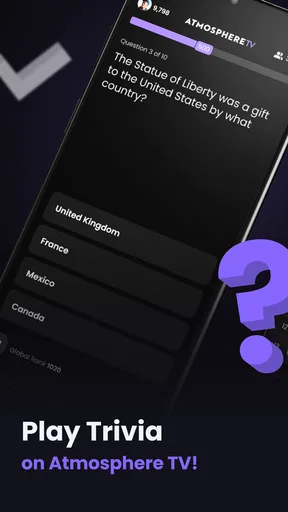

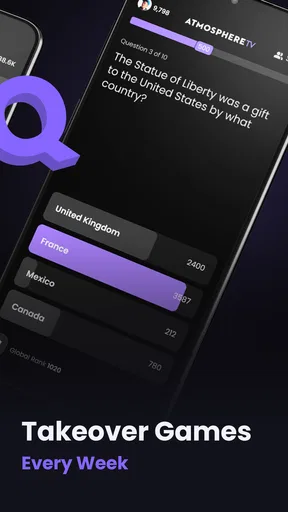


Our Review of Atmosphere Trivia
 Analysis by Appyee
I tried Atmosphere Trivia as the kind of game you open when a group wants something social but nobody wants to learn a complicated rulebook. It is a free trivia game from Rarefied Atmosphere, Inc., built around playing questions with friends and competing against people you know as “nemeses.” That framing matters: this is less about a solitary quiz routine and more about creating a little friendly tension around the same screen.
My first impression was that the game understands the value of a quick start. Trivia works best when the first question arrives before the room loses interest, and the design is clearly aimed at turning an ordinary evening into a shared activity. I would recommend it most readily to people who already have a small group willing to answer, argue, laugh at wrong guesses, and play another round immediately after a close result.
How the game builds a reason to keep playing
I look at the game’s replay appeal through the small social goals that build from one session to the next: a close result, a surprising answer, or a familiar rival who now has something to prove. That kind of momentum works best when the group keeps the stakes playful and makes room for newer players. It also raises a practical question for shared play: how can everyone join in without turning one device or one account into a source of friction?
Early goals that make the first round matter
The early goal is straightforward: answer well, beat the people you are playing against, and establish who knows more. That sounds simple, but it gives the opening session a useful shape. You do not need to understand a long-term economy or memorize a complicated progression tree before the game becomes enjoyable. The first challenge is social and immediate, which makes the game approachable for casual players.
That simplicity is also the first trade-off. Players who expect a large adventure, a collection system, or a deep single-player campaign may find the opening too dependent on the group. The game’s energy comes from comparison. If everyone treats it as a private quiz, much of its personality disappears. I would not choose it as my main trivia option for quiet solo practice; I would choose it when I want the questions to become conversation.
A useful way to introduce it is to avoid making the first session feel like a serious tournament. Let everyone play a few rounds, notice which subjects create the most debate, and allow the weaker player to settle in before turning every answer into a rivalry. That approach makes the early goal feel motivating rather than intimidating. It also reveals whether your group enjoys the game’s central rhythm before anyone commits to a longer evening.
The “nemesis” idea gives ordinary wins more personality. Beating a stranger on a leaderboard can feel abstract, while beating the friend who always claims to know everything creates an immediate story. In my experience, that kind of personal target is more effective than a generic score because it gives players a reason to care about the next question. The best matches are not necessarily the ones with the biggest score difference; they are the ones where everyone believes the result could change.
Progress signals without turning trivia into homework
Trivia games need some way to show that a session mattered. Here, the clearest progress signal is the changing relationship between players: who is ahead, who is catching up, and who has become the person everyone wants to challenge next. That is a good fit for a social quiz because it keeps progress understandable. You do not need to study a separate set of menus to know whether you are improving.
At the same time, this kind of progress is less tangible than unlocking a new character or building a collection. If you prefer visible rewards that accumulate even when you play alone, a more traditional quiz app may be more satisfying. Atmosphere Trivia relies on the memory of close matches and recurring rivalries. Its progression is strongest when the same people return often enough for those rivalries to develop.
I found that the most useful way to read the game’s progress is not simply to count wins. Pay attention to the types of questions that repeatedly decide a round. If one player dominates a particular area, changing the order of challenges or discussing the answer afterward can keep the contest from becoming predictable. This turns mistakes into a practical learning loop without making the game feel like a study tool.
Another small but important point is that a close loss can be healthier for retention than an easy win. When the result feels reachable, the losing player has a clear reason to try again. If one person consistently overwhelms everyone, the group should treat the match as entertainment rather than a formal competition, or rotate opponents so the same imbalance does not drain the room. The game can support friendly rivalry, but the players still control whether that rivalry remains friendly.
Difficulty and the changing feel of a match
The difficulty of a trivia game is never only about the questions. It also depends on how familiar the players are with one another, whether they share the same interests, and how comfortable they are admitting uncertainty. A question that is obvious to one person can be completely inaccessible to another. That makes the game’s challenge naturally uneven, especially in mixed groups.
Atmosphere Trivia works best when the group accepts that unevenness as part of the fun. I would be cautious about presenting it to people who dislike public mistakes or who expect every round to measure knowledge in a perfectly balanced way. The social setting can soften a wrong answer, but it can also magnify embarrassment if the group treats every miss as evidence that someone is not keeping up.
For a better difficulty curve, I would start with a relaxed session and watch the pace rather than rushing to prove who is the expert. Give new players room to understand how the game feels, and avoid turning one strong opening performance into a permanent label. Once everyone has settled in, the challenge becomes more interesting because players begin anticipating each other’s strengths instead of merely reacting to questions.
There is also a strategic difference between playing for accuracy and playing for momentum. A cautious player may protect a lead, while a trailing player may become more willing to take risks or answer quickly. Even without a complicated ruleset, those choices create texture. The game’s strongest moments come when the score is close enough that a single decision changes the mood of the room.
That said, players looking for a carefully graduated solo difficulty ladder should consider another type of trivia app. A dedicated study quiz can offer more control over subjects and repetition, while a competitive multiplayer quiz can provide a larger pool of opponents. This game’s appeal is narrower and more personal: it is about the people at the table or in the same social circle, not about constructing the perfect training program.
What keeps the group returning
Retention here comes from social pressure rather than from a promise of endless mechanical expansion. A friend who narrowly won last time becomes an obvious target. A player who made a surprising comeback becomes someone the group wants to test again. Those small narratives are enough to carry another session when the participants enjoy one another’s company.
I think that is both the game’s main strength and its biggest limitation. If you have a regular group, the rivalry can make a free trivia game feel more substantial than its basic premise suggests. If your friends are rarely available or prefer different kinds of games, the motivation may fade quickly. The app cannot manufacture chemistry between players; it can only give that chemistry a place to play out.
For an everyday scenario, imagine a few friends waiting for food or relaxing after dinner. Instead of opening separate social feeds, one person starts a match and everyone has a shared focus. The useful part is not merely filling spare minutes. The questions create natural interruptions for conversation: someone explains a surprising answer, another person challenges the result, and a quiet guest gets an easy way to join in. That makes it more suitable for a casual gathering than for a commute where you want uninterrupted solo play.
Another practical use is as a short warm-up before a larger game night. I would play a few rounds first, because trivia quickly shows who enjoys competition and who would rather participate informally. If the group becomes too focused on winning, switch the tone by treating unusual answers and debates as the main entertainment. If the group stays engaged, the rivalry can become the evening’s central activity without requiring much preparation.
The game is also a reasonable choice for households with mixed ages because its content rating is Everyone. I would still judge the setting by the players themselves, since an age label does not guarantee that every question will suit every person’s interests or knowledge. The broad rating makes it easier to suggest for a family or mixed group, but the quality of the session will depend on how the group handles different skill levels.
Where it sits beside familiar alternatives
Compared with a solo trivia app, this game gives up some control in exchange for social tension. A solo alternative is better when I want to repeat a subject, improve privately, or play at my own pace. Atmosphere Trivia is better when I want another person’s reaction to be part of the experience. The choice is less about which app has the “best” questions and more about whether I want a personal test or a shared contest.
Compared with a large online quiz platform, its attraction is the feeling of a known opponent. Online competition can provide a steady stream of new players, but it may not create the same sense of history as facing the friend who beat me yesterday. On the other hand, a bigger platform may be more reliable when my usual group is unavailable. I would keep that distinction in mind before installing: this is a social tool for a particular circle, not a replacement for every kind of trivia experience.
It also differs from party games that depend on drawing, acting, or improvisation. Trivia gives quieter players a clearer way to participate, since they can contribute through knowledge rather than performance. However, it offers less variety for people who want several different mini-games in one package. If your group enjoys changing activities every few minutes, a broader party collection may hold attention better.
The free price lowers the risk of trying it with friends. I can suggest it without asking everyone to buy in first, which is important for a casual gathering. Still, free does not automatically mean it will fit every group. The real cost is attention: if players are not interested in answering questions or comparing results, no price advantage will fix that mismatch.
Device details and practical expectations
Atmosphere Trivia was released on October 9, 2023, and the current version is 3.0.1 (1777). It requires Android 8.0 or later, so it should be considered alongside the age of the phones in your group before planning a shared session. The game has passed one hundred thousand installs, carries a 4.7 average from around 2.7 thousand ratings, and has 356 written reviews. Those figures suggest that it has found a real audience, while still leaving room for a personal trial rather than treating popularity as proof that every group will enjoy it.
The app comes from Rarefied Atmosphere, Inc., and its store summary emphasizes playing trivia and competing with nemeses. That is a fair description of the experience I would expect from it: the game is built around a contest with recognizable opponents, not around a long narrative campaign. Its Everyone rating makes it broadly approachable, but I would still explain the competitive tone to younger or more sensitive players before making the rivalry intense.
Before a gathering, I would check that the people who plan to play are comfortable using devices during the activity. That sounds obvious, but it affects the atmosphere. A trivia game can bring a group together when everyone is looking at the same challenge; it can also become another reason for people to retreat into separate screens if the session is not introduced clearly. Starting with a defined round and an agreed stopping point helps keep the app in its proper role.
Who should play, and who should pass
I would recommend it to friends who enjoy knowledge-based competition, families looking for a simple shared activity, and hosts who want a low-preparation game for a relaxed evening. It is especially appealing when the same people meet repeatedly, because recurring opponents give the results more meaning. The game can turn a casual “one more round” into a small tradition.
I would be less likely to recommend it to someone seeking a deep solo progression system, a focused educational curriculum, or a broad party-game collection. Players who dislike being put on the spot may also prefer a private quiz. Likewise, if your group has a large knowledge gap and does not enjoy playful teasing, the competitive framing could make the session feel uneven instead of welcoming.
There is a useful middle ground for hesitant players: make the first session cooperative in spirit even if the scoring remains competitive. Ask people to explain answers, celebrate unexpected knowledge, and avoid using the result to rank everyone permanently. This preserves the game’s central rivalry while giving newcomers a reason to return. Once players understand that a loss is not a social verdict, the challenge usually becomes more enjoyable.
My progression verdict
Atmosphere Trivia sustains play through clear short-term goals, recognizable rivals, and the possibility of a close rematch. Its progress signals are social rather than elaborate, and that is exactly why it can work so well in a group that already has some shared history. The pacing is strongest when the match remains quick enough to keep conversation alive and close enough to make the next round feel worthwhile.
My main reservation is that the same design can feel thin when there is no dependable group. I would not install it expecting a deep personal journey or a carefully structured ladder of unlocks. I would install it as a lightweight way to give friends something to compete over. The deciding question is not whether you enjoy trivia in general, but whether you enjoy trivia more when the opponent is someone you know.
For that audience, the free entry point, broad age rating, and strong average rating make it easy to try. I would begin with a short, low-pressure session, identify which rivalries feel fun rather than uncomfortable, and let the group decide whether the rematch is the real reward. If that sounds like your kind of evening, Atmosphere Trivia is a focused and personable choice. If you want private practice, extensive progression, or a constant supply of unfamiliar opponents, a different trivia format will probably serve you better.
Privacy and Permissions
See what permissions an app requests and how it handles your data.
- Location
- approximate location (network-based), precise location (GPS and network-based)
- Camera
- take pictures and videos
- Other
- view network connections, full network access, run at startup, control vibration, prevent device from sleeping
Verdict
Strengths of Atmosphere Trivia
- Wide range of trivia categories keeps sessions varied.
- Simple interface makes it easy to start playing quickly.
- Short rounds suit quick entertainment breaks.
- Helpful for learning interesting facts while playing.
- Works well for friendly competition with other players.
Limitations of Atmosphere Trivia
- Some questions may feel too easy for experienced trivia fans.
- Difficulty can vary noticeably between categories.
- Repeated questions may reduce replay value over time.
- Requires concentration, which may not suit casual multitasking.
- Limited appeal if you prefer trivia focused on one subject.
Similar Picks in This Category
View All
Millionaire 2026 Quiz & Trivia
Quiz & Trivia Games by Submarine Apps4.5

Brain Test 2: Tricky Stories
Unico Studio4.7

Trivia Crack: Brain Quiz Games
etermax4.4

QuizzLand. Quiz & Trivia game
Quiz & Trivia Games by Mno Go Apps4.8

Brain Test: Tricky Puzzles
Unico Studio4.7

Logo Quiz
bubble quiz games4.5
Frequently Asked Questions
What is Atmosphere Trivia and how does the game work?
Atmosphere Trivia is a quiz-focused game designed to test your knowledge through questions covering different subjects and difficulty levels. After starting a round, you select the answer you believe is correct and receive immediate feedback. Depending on the available modes, the game may also include timed questions, score tracking, challenges, or competitive elements that encourage you to improve your results over multiple sessions.
Can I play Atmosphere Trivia without an internet connection?
Offline availability can depend on the version of Atmosphere Trivia and the specific features you want to use. Basic question content may work without a connection if it has already been downloaded, but online leaderboards, account synchronization, advertisements, updates, and multiplayer functions generally require internet access. Before traveling or playing offline, open the game while connected and check which modes remain available.
Is Atmosphere Trivia suitable for children and family play?
Atmosphere Trivia can be suitable for family use when the questions match the players’ ages and knowledge levels. However, quiz topics, advertisements, online features, and the difficulty of the question database may vary between versions. Parents should review the app-store age rating, privacy information, and any in-app communication or purchase options before allowing younger children to play independently.
Does Atmosphere Trivia include advertisements or in-app purchases?
Many free trivia games use advertisements or optional purchases to support development, and Atmosphere Trivia may offer similar monetization features depending on the platform and region. Ads can appear between rounds or when unlocking bonuses, while purchases may remove advertising or provide additional content. Check the official store listing for current pricing and review the purchase settings before handing the device to children.
What permissions and personal information does Atmosphere Trivia require?
The permissions requested by Atmosphere Trivia may differ between Android and iOS and can change with future updates. A trivia game normally needs limited access, but optional features such as notifications, analytics, personalized advertising, social accounts, or cloud progress may involve additional data collection. Read the current privacy policy and app-store permission details, and deny permissions that are not necessary for the features you plan to use.
Play our best games!


